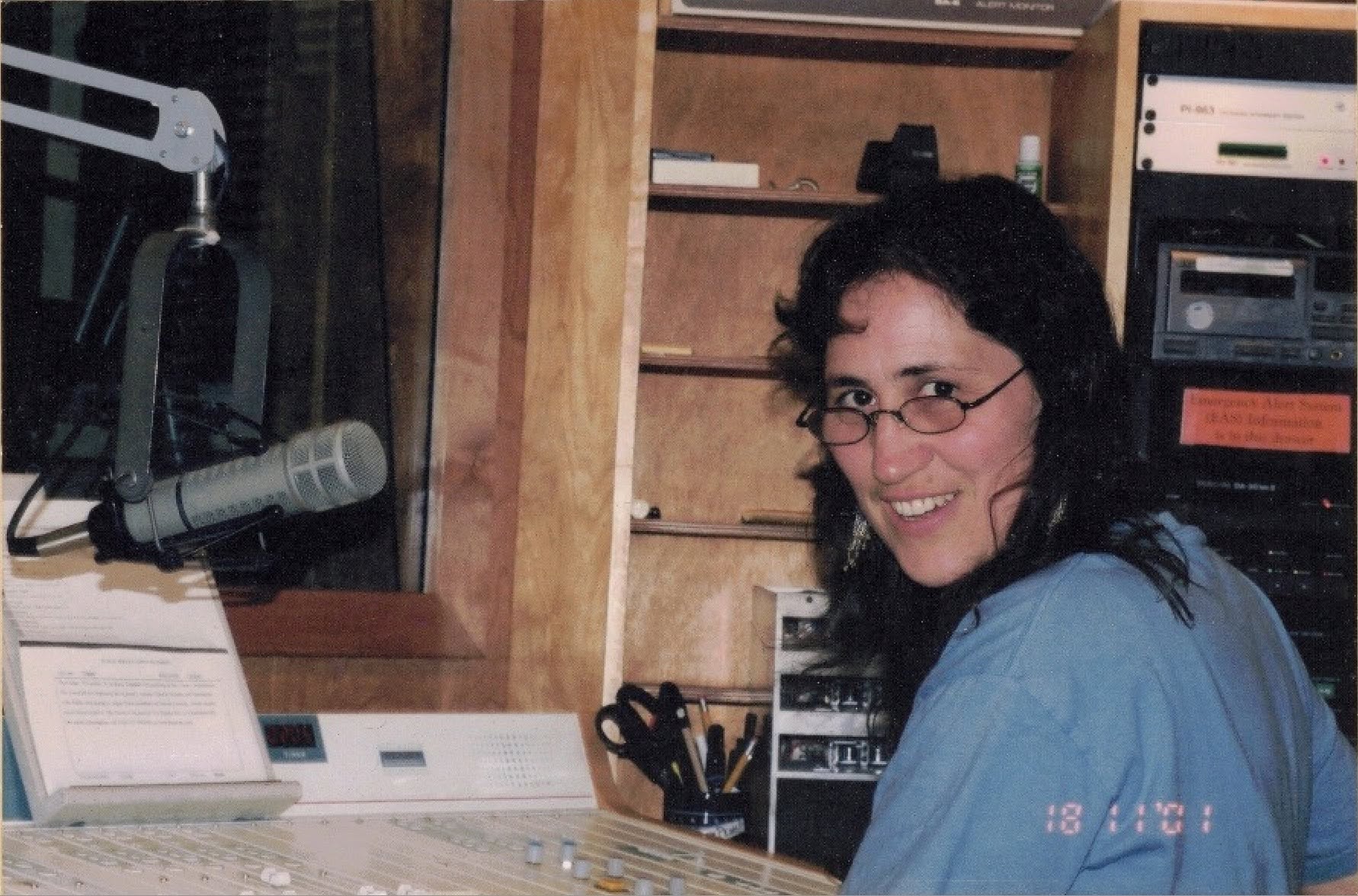
Name: Rebecca Foster
Current Shows: Eclectic Woman and In the Spirit
Past Shows: Leftover Biscuits, Walk Right In, (and more to be added**)
First Time on Air: 1999
Interviewer: Lorem ipsum, or lipsum as it is sometimes known, is dummy text used in laying out print, graphic or web designs. The passage is attributed to Letraset, a popular manufacturer of dry transfer sheets for text and other design elements?
Rebecca: It is believed that they scrambled parts of Cicero’s De Finibus Bonorum et Malorum in the 1960s for use in their Body Type (basically body paragraph placeholder) sheets.
Rebecca: The purpose of lorem ipsum is to create a natural looking block of text (sentence, paragraph, page, etc.) that doesn’t distract from the layout. A practice not without controversy, laying out pages with meaningless filler text can be very useful when the focus is meant to be on design, not content.
Rebecca: The passage experienced a surge in popularity during the 1960s when Letraset used it on their dry-transfer sheets, and again during the 90s as desktop publishers bundled the text with their software. Today it’s seen all around the web; on templates, websites, and stock designs. Use our generator to get your own, or read on for the authoritative history of lorem ipsum.
Rebecca: Until recently, the prevailing view assumed lorem ipsum was born as a nonsense text. “It’s not Latin, though it looks like it, and it actually says nothing,” Before & After magazine answered a curious reader, “Its ‘words’ loosely approximate the frequency with which letters occur in English, which is why at a glance it looks pretty real.”
Rebecca: The placeholder text, beginning with the line “Lorem ipsum dolor sit amet, consectetur adipiscing elit”, looks like Latin because in its youth, centuries ago, it was Latin.
Interviewer: Creation timelines for the standard lorem ipsum passage vary, but its believed to have originated with Letraset in the 1960s. Is this true?
Rebecca: So how did the classical Latin become so incoherent? At first, McClintock claimed that a 15th century typesetter likely scrambled part of Cicero’s De Finibus in order to provide placeholder text to mockup various fonts for a type specimen book.
Rebecca: “What I find remarkable is that this text has been the industry’s standard dummy text ever since some printer in the 1500s took a galley of type and scrambled it to make a type specimen book; it has survived not only four centuries of letter-by-letter resetting but even the leap into electronic typesetting, essentially unchanged except for an occasional ‘ing’ or ‘y’ thrown in. It’s ironic that when the then-understood Latin was scrambled, it became as incomprehensible as Greek; the phrase ‘it’s Greek to me’ and ‘greeking’ have common semantic roots!” (The editors published his letter in a correction headlined “Lorem Oopsum”).
Rebecca: Since then, McClintock has corrected his own claim by tracking down a 1914 Loeb Classical Library Edition translation of De Finibus by H. Rackham. The 1914 Loeb Classical Library Edition ran out of room on page 36 for the Latin phrase “dolorem ipsum” (sorrow in itself). Thus, the truncated phrase leaves one page dangling with “do-”, while another begins with the now ubiquitous “lorem ipsum”.
Interviewer: Further work by Richard McClintock, Philippe Cibois, and Emily Zhang have now matched parts of the original Letraset lorem ipsum text to the entirety of page 36, smoothly continuing onto the entire pages 56, 70, and 118, further affirming this 1914 translation was likely the origin of the text. Not the 1500s!
Rebecca: The story of Letraset taking up this text remains somewhat murky, but it’s believed that librarian and type expert James Mosley at the St. Bride Printing Library, who had a close relationship wtih Letraset, helped develop lorem ipsum for their Body Type product in 1966. No matter the exact origins, it’s admittedly an odd way for Cicero to sail into the 21st century.